PORTSOY is a seaport in the
shire of Banff, and parish of Fordyce. It is 178 miles north of
Edinburgh, 8 miles W. by N. of Banff and 80 miles east of Inverness. It
is situated on a tongue of land, which, projecting into the Moray Firth,
forms a small by safe harbour. Of all the many ports along the
Aberdeenshire and Moray coasts, Portsoy was one of the earliest to be
established and capable of admitting vessels of 150 tons although after
an extremely violent storm in January 1839 it was later rebuilt in 1884
to hold 12 vessels of 100 tons.
The town is small and irregularly built, but as a
port it is in a thriving condition ; the point of land on which it
stands forms the safe harbour, which has now been greatly improved and
is now sufficiently deep to moor vessels of upwards of two hundred tons
burthen. Besides the proceeds of the herring fishery, which has been
actively prosecuted for some years, it enjoys a trade in the export of
grain and serpentine marble stone, and the importation of coal.
Fish-curing, flax-dressing, a woollen manufactory, and a distillery, are
prominent branches among the general domestic business, which, combined
with the current revenue resulting from the traffic of its port, has
elevated Portsoy into rather a consequential position as a commercial
town.
The harbour they built at Portsoy comprised a massive
breakwater on the seaward side and a number of quays. The construction
uses large stones set vertically, apparently because it was believed
that this made them less likely to be washed away by the sea. The theory
seem to have worked, because the Old Harbour you see today is largely
the harbour that was built in 1692. Around the Old Harbour are a number
of impressive buildings that date back to the end of the 1600s or early
1700s. The trade in Portsoy's early days was very varied, and included
the import of coal for domestic fires and the export of locally produced
thread and linen to England. A particular speciality was locally
quarried green Portsoy marble or serpentine. This was extracted from a
quarry to the west of the town, and some of it found its way into the
fixtures and fittings of Louis XIV's Palace of Versailles. Portsoy
marble is still worked locally and a range of products are on view in
one of the warehouses overlooking the harbour.
A lot of coal was landed at Portsoy and a
trade was carried out with the Baltic with vessels bringing bone and
returning with herring. Grain is also shipped but no mention can be
found of imports of flax or hemp from the Baltic. A survey on June 3rd.
1776 found Portsoy manufacturing stocking threads, for the London and
Nottingham markets, and carried on to a great extent.
In some seasons three hundred tons of flax are
there imported from Holland; (no mention of Russian flax) with Cullen,
Huntly, Keith, and other manufacturing villages, also supplied thence:
this therefore an expense of twenty or thirty thousand pounds a year,
which might be evaded by raising flax at home. There are generally from
fifteen to twenty vessels belonging to the place, from forty to a
hundred and fifty tons burden: for some of these profitable employment
is found, at the fisheries among the Western Isles; each is equipped
with three boats, and require eighteen hands: they sail early in the
spring, about the beginning of February, for Loch Gairloch; and apply to
the cod-fishing there until the first of May, when it is usual to go to
the banks of Barra-Head, where they catch Ling. All the fish which they
take are salted and dried on the spot; and the vessels return in August,
on purpose to send their cargoes to the proper markets along with
salmon. The vessels which carry these to the coasts of Spain and
Portugal, or up to the Mediterranean; together with those which have
been sent out with grain; return with wines, salt, flax, wood, iron, and
whatever other
 articles are required, either for home consumption, or
those branches of trade in which the inhabitants of the place are
engaged. Many Scottish boats were attacked by pirates in the 14th/15th
centuries while trading to the Baltic and even as late as 7th Aug 1780 a
report said that a French Privateer held 14 on board
for ransom, some of them for large sums; had sunk one vessel, and sent
four hemp and flax vessels to Norway for sale.. Actions like these
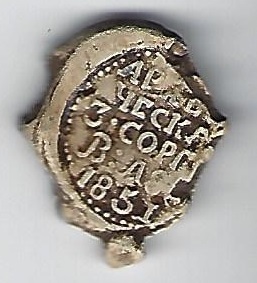
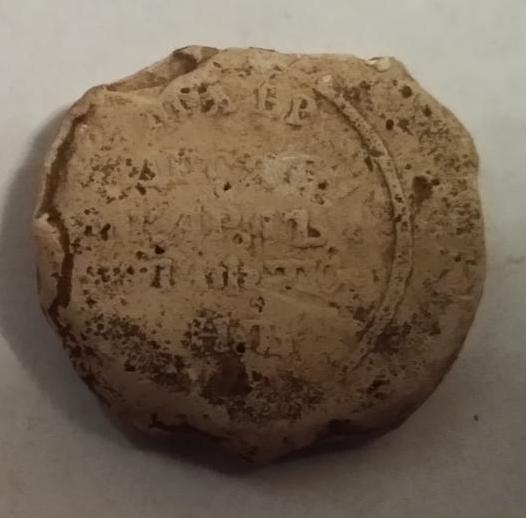
could account for the occasional lead flax seal being found in Norway. By 1797 the people are in general
disposed to industry. Since the failure of thread-bleaching at Portsoy,
there is no manufacture of consequence carried on within the parish. But
most of the inhabitants raise as much flax, and weave as much linen
cloth, as serve their families. Perhaps 1000 yards of the cloth
manufactured in it are sold out of the parish.
articles are required, either for home consumption, or
those branches of trade in which the inhabitants of the place are
engaged. Many Scottish boats were attacked by pirates in the 14th/15th
centuries while trading to the Baltic and even as late as 7th Aug 1780 a
report said that a French Privateer held 14 on board
for ransom, some of them for large sums; had sunk one vessel, and sent
four hemp and flax vessels to Norway for sale.. Actions like these
could account for the occasional lead flax seal being found in Norway. By 1797 the people are in general
disposed to industry. Since the failure of thread-bleaching at Portsoy,
there is no manufacture of consequence carried on within the parish. But
most of the inhabitants raise as much flax, and weave as much linen
cloth, as serve their families. Perhaps 1000 yards of the cloth
manufactured in it are sold out of the parish.
Portsoy Old Harbour was built at Portsoy in
1692 was a vast breakwater on the seaward side and a number of quays.
Large stones were set vertically as it was said this made them less
likely to be washed away by the sea. The Old Harbour can still be seen
today and is mostly the harbour that was built in 1692. Portsoy’s first
harbour was considered to be the safest in the North East, which meant
that it had a thriving trade with both England and the Continent. The
new harbour was built between 1825-28 to meet the demands of the herring
boom and the volume of trade going through Portsoy. Throughout the
nineteenth century a herring boom brought further prosperity to Portsoy,
with a herring fleet totalling 57 boats at its peak, though usually
averaging 40-50 boats in harbour employing 108 resident fishermen and
boys. The harbour was washed away in an extremely violent storm in
January 1839 and was only rebuilt in 1884 to hold 12 vessels of 100
tons, though most ships visiting the harbour were much smaller. The main
imports were coal and bones from the Baltic, and the chief exports
grain, herring, and potatoes. Aside from industries around the harbour,
other industries in the town at the end of the nineteenth century were a
small rope works and a bone mill, and in the neighbourhood there was a
wool mill, and the Glenglassaugh distillery which was built around 1875.
The trade in Portsoy's early days was very varied, and included the
import of coal for domestic fires and the export of locally produced
thread and linen to England.
From all accounts the imports from the Baltic were bones
not flax and no flax seals have been found here, yet.